
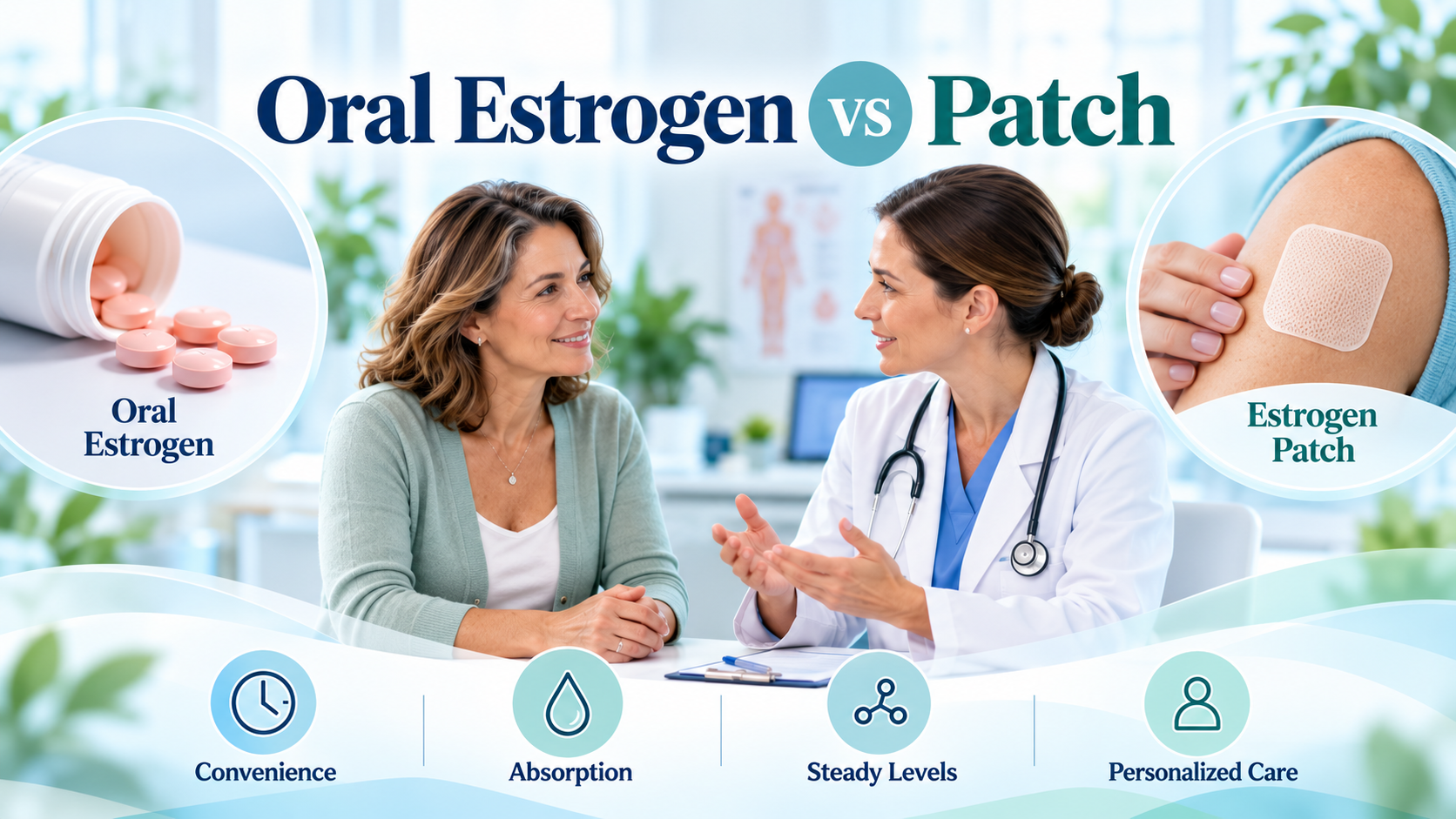
Oral estrogen pills travel through your liver before reaching your bloodstream, while the patch delivers estrogen straight through your skin.
That difference changes how each option affects blood clot risk, blood pressure, and daily dosing.
This guide compares the research on safety and symptom relief for both routes, then walks through how to tell which one fits your health history.
If you’re weighing oral estrogen vs patch, you’ve probably already had the harder conversation: deciding to start hormone therapy at all.
Maybe the symptoms of low estrogen crept in slowly, or maybe everything shifted fast once perimenopause started.
Either way, the delivery method you choose next matters almost as much as the decision to treat your symptoms in the first place.
SEE WHICH HRT OPTION IS RIGHT FOR YOU
What Is the Main Difference Between Oral Estrogen and the Patch?
Oral estrogen tablets travel through your digestive system and liver before entering your bloodstream, a process called first-pass metabolism.
The patch skips that step, releasing estrogen through your skin straight into your blood.
This changes how your liver handles clotting factors and blood pressure, which is why the two routes carry different risk profiles.
Your liver doesn’t just filter estrogen.
It also uses that first pass to produce more clotting proteins and shift how your body handles fat in the blood.
Oral tablets need a bigger dose to begin with, since a large portion breaks down in the liver before it ever reaches your tissues.
The patch avoids this step almost entirely, delivering a steadier, lower dose directly into circulation.
How Each Method Gets Estrogen Into Your Body
Oral Estrogen (Pills)
Oral estrogen comes as a daily tablet, usually estradiol or conjugated estrogens.
You swallow it, your gut absorbs it, and your liver processes it before it reaches the rest of your body.
Because so much gets used up in that first pass, the starting dose is higher than what a patch needs to produce a similar effect.
Transdermal Patch
The patch sticks to your skin, usually on your lower abdomen, hip, or buttock, and releases estrogen continuously for several days before you swap it out.
Most brands are changed once or twice a week.
Because the patch bypasses your digestive tract and liver, much lower doses can produce blood estrogen levels similar to a full oral dose.
Is the Estrogen Patch Safer Than the Pill?
A 2015 analysis pooling 15 studies found that oral estrogen carried about 1.6 times the risk of a first blood clot and roughly double the risk of deep vein thrombosis compared to the patch, with a possible increase in stroke risk as well.
Heart attack risk did not differ meaningfully between the two.
That evidence is observational, not a controlled experiment, so it shows an association rather than definitive cause and effect.
Even so, it’s consistent enough that the UK’s national health guidelines now recommend considering the transdermal route over oral tablets for anyone with a BMI over 30 or other clot risk factors, and refer higher-risk patients to a specialist before starting either one.
Does Oral Estrogen Raise Blood Pressure More Than the Patch?
A 2023 study of more than 112,000 women found that those taking oral estrogen pills had a 14 percent higher risk of developing high blood pressure than women using patches or topical creams, and a 19 percent higher risk compared to vaginal forms of estrogen.
Researchers tracked new blood pressure diagnoses for at least a year after women started treatment.
The leading theory is that oral estrogen’s trip through the liver changes how your body regulates blood vessel tone, an effect the patch mostly sidesteps by entering circulation directly.
Oral Estrogen vs Patch: Symptom Relief Compared
Both routes are genuinely effective at easing menopause symptoms.
An early clinical trial found that all three hormone regimens it tested, two patch doses and one oral dose, relieved hot flashes and protected the uterine lining, with the lowest-dose patch causing the fewest side effects.
More recent research adds some nuance: oral estrogen may work slightly faster for hot flashes in some women, while the patch tends to produce a more noticeable improvement in vaginal dryness and discomfort during sex.
Here’s how the two options stack up across the factors that usually drive the decision.
| Factor | Oral Estrogen (Pill) | Patch |
|---|---|---|
| Hot flash relief | Effective; may feel faster for some women | Equally effective, with steadier day-to-day control |
| Vaginal dryness relief | Effective | Often more noticeable improvement |
| Blood clot risk | Higher | Lower |
| Blood pressure effect | More likely to raise it | Smaller effect |
| Liver and triglyceride impact | Processed through the liver; can raise triglycerides more | Bypasses the liver; less metabolic impact |
Who Should Avoid Oral Estrogen Pills?
Oral estrogen isn’t the right starting point for everyone.
Your provider will likely steer you toward the patch or another non-oral option if you have any of the following:
- A personal history of blood clots, deep vein thrombosis, or pulmonary embolism
- Migraine with aura
- A smoking habit, especially after age 35
- A BMI over 30
- Active liver disease
- Very high triglycerides
- Gallbladder disease
- A strong family history of clotting disorders
If several of these apply to you, your provider may also want you evaluated by a blood specialist before starting any form of estrogen, oral or otherwise.
Who Might Prefer the Patch Over the Pill?
The patch tends to make more sense if you have any of the risk factors above, if you have trouble remembering a daily pill, or if you simply want steadier hormone levels with less day-to-day fluctuation.
Some women also switch to the patch specifically because they plan to stay on hormone therapy long-term.
Women who intend to continue hormone therapy well past 65 often lean toward the patch because of its smaller cardiovascular signal over time, which matters if you’re also weighing whether you can stay on HRT for the rest of your life.
The right choice can also shift with time.
The route that worked well when signs perimenopause is ending started showing up may not be the best fit once you’re fully postmenopausal, since your risk profile and symptoms change with age.
SEE WHICH OPTION MAKES SENSE FOR YOU
Other Delivery Options Worth Knowing About
Pills and patches aren’t the only choices.
Estrogen gels and sprays applied to the skin work on a similar principle to the patch, bypassing the liver, but need to be reapplied daily.
Vaginal rings and creams deliver estrogen locally and are often used for dryness alone rather than full symptom control.
Pellets, inserted under the skin, release hormone steadily for three to six months, but unlike a patch, they can’t be removed or adjusted once in place if the dose turns out to be too high.
How Youthgevity Helps You Choose the Right Delivery Method
None of this works as a one-size-fits-all answer, which is exactly why Youthgevity starts with lab work instead of guesswork.
Our personalized hormone therapy program for women begins with testing your actual hormone levels rather than assuming a standard dose will fit your body.
Getting your levels checked at the right point in your cycle or life stage gives your specialist an accurate baseline before recommending oral estrogen, a patch, or another route entirely.
From there, a board-certified specialist reviews your personal and family health history, your clotting and blood pressure risk, and your day-to-day routine before helping you settle on the method that fits, with virtual visits and medication shipped directly to you.
What Should You Ask Your Provider Before Choosing?
A short list of questions can make this decision much clearer during your appointment.
Bring these up before you commit to either route:
- Do I have any personal or family history of blood clots?
- Do I get migraines with aura?
- What does my current blood pressure and cholesterol look like?
- How much does a daily routine versus a twice-weekly patch change matter to me?
- What will my insurance actually cover for each option?
- Could my dose need to change as I move further into perimenopause or menopause?
Whether you’re just starting hormone therapy or wondering if you can stay on it for years to come, the right delivery method is allowed to change as your body does.
A virtual visit with a Youthgevity specialist can match your health history to the safest starting point, rather than leaving you to guess between a pill and a patch on your own.
FAQs: Oral Estrogen vs Patch
Is the estrogen patch better than the pill for hot flashes?
Both are effective for hot flashes. Oral estrogen may bring relief slightly faster for some women, while the patch tends to provide steadier, more consistent control since it avoids the daily ups and downs of a swallowed dose.
Does the patch lower your risk of blood clots compared to the pill?
Research consistently shows lower blood clot risk with the patch than with oral estrogen, since the patch bypasses the liver processing that increases clotting factor production. This is why guidelines favor the patch for women who already have clot risk factors.
How long does it take for an estrogen patch to start working?
Many women notice improvement in hot flashes and night sweats within one to two weeks of starting a patch, though it can take four to six weeks to feel the full effect as your levels stabilize.
Can you switch from oral estrogen to a patch?
Yes. Switching between oral and transdermal estrogen is common and usually straightforward, though your provider will adjust your dose since the two forms aren’t absorbed the same way.
Is the estrogen patch more expensive than the pill?
It depends on your insurance plan and the specific brand. Generic oral tablets are often the cheaper option out of pocket, while patch pricing varies more widely depending on your coverage.
Do you still need progesterone if you use an estrogen patch?
If you still have a uterus, yes. Estrogen alone, whether taken orally or through a patch, raises the risk of endometrial cancer without progesterone to balance it.