
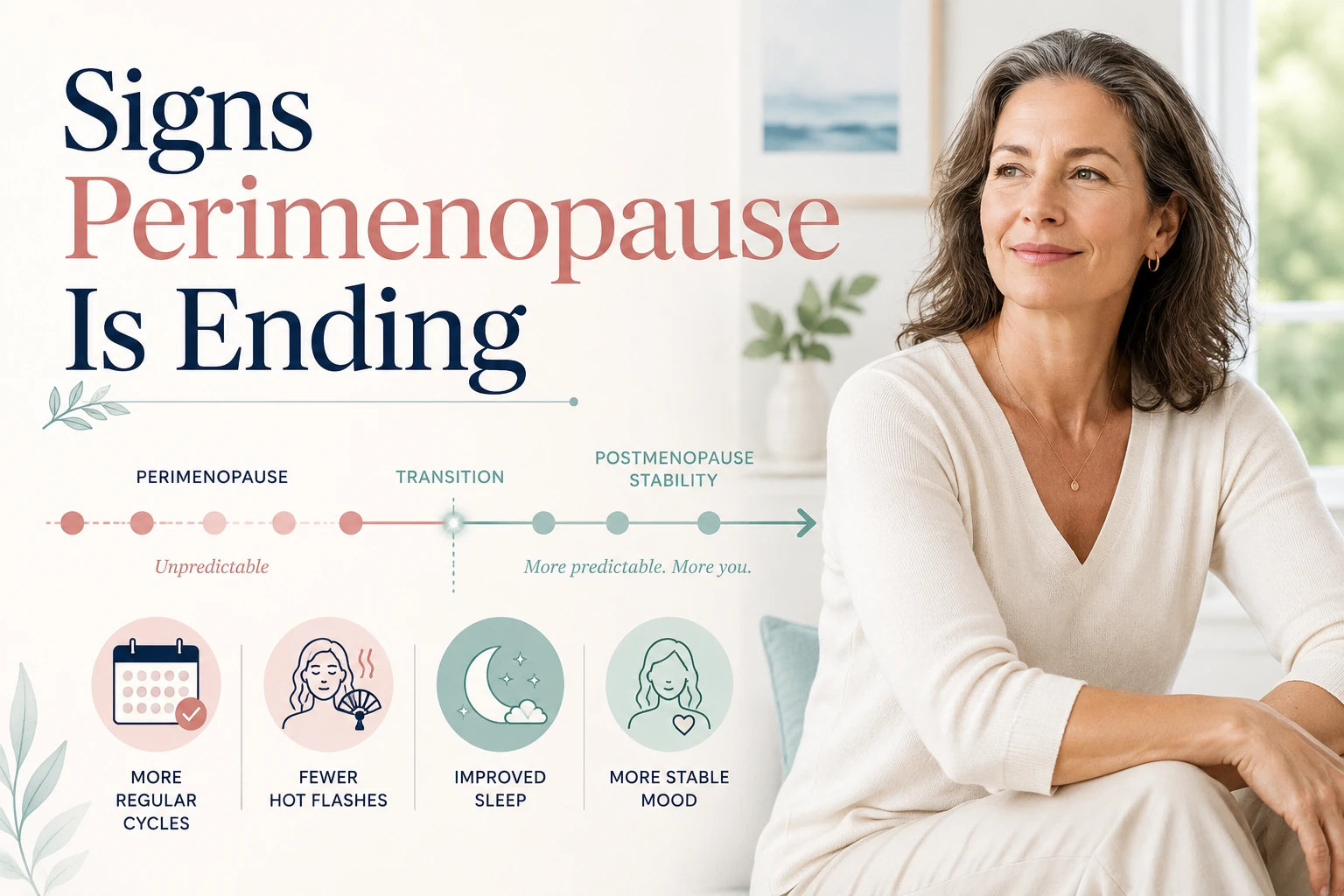
Perimenopause usually starts winding down with longer gaps between periods, hot flashes that shift in pattern, and mood or sleep that finally starts to steady out.
There’s no single test that confirms it’s ending, since hormone levels swing too much to be reliable from one day to the next.
This guide walks through the real signs, what typically happens next, and when late-stage symptoms are worth a doctor’s visit.
If your periods have gone quiet for weeks at a time, or your hot flashes seem to be changing shape instead of easing up, you might be wondering about the signs perimenopause is ending.
That question matters, because the last stretch of perimenopause looks different from the earlier years, and knowing what’s normal can save you a lot of worry.
Perimenopause doesn’t end with a switch flipping.
It fades out gradually, often in a pattern your body has been building toward for months or years.
Below are the changes worth watching for, what the research says about timing, and when it’s worth calling a doctor instead of waiting it out.
What Does It Mean When Perimenopause Is Ending?
Perimenopause is ending when your ovaries are producing less estrogen and progesterone often enough that ovulation becomes rare, periods stretch further apart, and symptoms shift in intensity or pattern.
This late stage typically leads directly into menopause, which is only confirmed after 12 full months without a period.
Doctors sometimes call this final stretch “late perimenopause.”
It’s different from early perimenopause, when your cycle might just be a few days off schedule.
In the late stage, ovulation becomes inconsistent enough that your body swings between higher and lower hormone levels in ways that feel less predictable, not more.
That unpredictability is part of why so many women feel caught off guard.
A global survey of more than 17,000 women found that hot flashes were the symptom women recognized most, yet fatigue, irritability, and low mood were what women actually reported experiencing most often.
In other words, what you expect perimenopause to feel like and what it actually feels like can be two different things.
Thinking of perimenopause as a gradual hormonal wind-down, rather than a single event, makes it easier to recognize when you’re in the final stretch instead of the early years.
Typical Duration of Late Perimenopause
The American College of Obstetricians and Gynecologists notes that perimenopause lasts an average of four years, though it can run as long as eight.
The late stage, the part most people mean when they ask about signs it’s ending, tends to be the final stretch of that window, the months where periods space out and symptoms start to shift rather than just intensify.
There’s no stopwatch running on this.
Genetics, smoking history, and even the age your mother reached menopause all play a role in how long your own transition lasts.
What matters more than a firm number is tracking the pattern of change in your own cycle and symptoms over the past several months.
What Are the Signs Perimenopause Is Ending?
The clearest signs perimenopause is ending are longer gaps between periods, hot flashes and sleep problems that start to shift instead of steadily worsening, mood that gradually levels out, and brain fog that begins to lift.
These changes tend to show up together rather than one at a time, which is what separates late perimenopause from the more sporadic early years.
A 2025 study of more than 4,400 US women found that women often carry a heavy symptom burden, and seek care for it, years earlier than the age most people associate with perimenopause, some as early as their early 30s.
That’s a reminder that timelines vary widely, and the signs below matter more than your exact age.
Your Periods Are Farther Apart, or Stop for Months at a Time
This is usually the clearest signal.
In early perimenopause, cycles might shorten or lengthen by a few days.
In the late stage, the clinical staging system doctors use defines it as going 60 days or more without a period, and eventually skipping several months in a row.
Some women also notice their flow gets lighter or shorter as ovulation becomes less frequent.
If you’re using hormone therapy, keep in mind that it changes your bleeding pattern too, which can make it hard to tell which changes come from your own hormones and which come from how HRT affects your cycle.
Hot Flashes and Night Sweats Shift in Pattern
Hot flashes don’t always fade quietly.
For some women they intensify right before tapering off, while for others they’ve already peaked and are becoming less frequent.
Night sweats often follow the same up-and-down pattern.
This shift, rather than a steady one-way decline, is part of what makes late perimenopause feel confusing.
If hot flashes are new or worsening for you, it’s worth comparing your experience to the broader list of symptoms of low estrogen.
Sleep Becomes More Disrupted, Then Gradually Steadies
Night sweats, anxiety, and hormone swings can all fragment sleep during perimenopause.
Many women find their worst sleep happens in the year or two before their last period, then gradually improves once hormone levels settle at a lower, steadier baseline.
If you’re waking up multiple times a night or lying awake for long stretches, that’s worth mentioning to a provider rather than treating as something to just push through.
Mood Swings Start to Level Out
Sharp mood swings are common earlier in perimenopause, when estrogen and progesterone rise and fall unpredictably within the same month.
As hormone levels drop to a lower, more consistent baseline, many women notice their mood stabilizes, even if it settles at a different point than before.
A study following nearly 1,000 perimenopausal and menopausal women found that after three months of hormone therapy, low mood improved in 69% of participants, which suggests mood-related symptoms respond well once hormone levels are addressed directly.
If mood swings have been a major part of your experience, that’s worth discussing with a provider rather than waiting for it to resolve on its own.
Brain Fog Begins to Lift
Trouble concentrating, forgetting words mid-sentence, and feeling mentally slower are common complaints during perimenopause.
In that same study of nearly 1,000 women, memory difficulties and concentration issues were each reported by more than 90% of participants, making them even more common than hot flashes in that group.
The good news is that cognitive symptoms often improve once hormone levels stop swinging so sharply.
If brain fog has been interfering with work or daily life, that’s a legitimate reason to seek treatment rather than something to just wait out.
Vaginal Dryness and Urinary Symptoms Become More Noticeable
Unlike hot flashes and mood swings, vaginal dryness and urinary symptoms tend to get worse rather than better as estrogen drops further.
This can show up as dryness, discomfort during sex, or more frequent urinary tract infections.
These symptoms often persist well past your last period, since the tissue changes behind them typically need direct treatment to improve.
It’s worth bringing up with a provider, because effective options exist and this isn’t a symptom that reliably resolves on its own.
Your Sex Drive Changes, in Either Direction
Sex drive doesn’t move in one predictable direction during late perimenopause.
Some women notice a drop tied to vaginal dryness, fatigue, or mood changes, while others find their libido actually increases once anxiety about unpredictable periods or pregnancy fades.
If low libido has been frustrating for you, it’s worth knowing that hormone shifts are a common, treatable cause rather than something you have to accept as permanent.
Joint Aches and Bone Density Changes Show Up
Joint stiffness, especially in the mornings, becomes more common as estrogen drops, since estrogen helps protect joint cartilage and bone.
Bone loss also speeds up during this window.
One study tracking bone density through the transition found the fastest rate of loss happened between ages 49 and 54, at roughly 1.39% per year at the femoral neck, a much faster pace than before or after that window.
That faster bone loss is closely tied to declining ovulation.
Research on perimenopausal bone density found that as the share of ovulatory cycles dropped from 67% to 33% over two years, bone loss accelerated right alongside it.
This is one of the more overlooked signs of late perimenopause, since joint aches often get dismissed as normal aging rather than connected to hormone changes.
Skin, Hair, and Weight Distribution Shift
Lower estrogen affects collagen production, which can leave skin feeling thinner or drier.
Hair may thin or grow more slowly. Many women also notice weight settling around the abdomen even without changes to diet or exercise, since falling estrogen shifts how the body stores fat.
None of these changes are dramatic on their own, but together with the signs above, they help paint a fuller picture of where you are in the transition.
GET HELP BALANCING YOUR HORMONES
Can a Blood Test Confirm Perimenopause Is Ending?
No single blood test can confirm perimenopause is ending.
Follicle-stimulating hormone, or FSH, is the hormone doctors most often check, but it swings so much from week to week during perimenopause that one result can look completely different a month later.
Most providers rely on your symptom pattern and cycle history over time instead.
FSH tests themselves are technically accurate, correctly measuring the hormone about 9 times out of 10.
The problem isn’t the test, it’s the timing.
Hormone levels during perimenopause can spike into menopausal range one week and drop back to premenopausal levels the next, so a single snapshot rarely tells the full story.
This is where tracking matters more than testing.
Comprehensive lab work done more than once, alongside a detailed history of your cycle and symptoms, gives a much clearer picture than any single result.
That’s the thinking behind female hormone therapy built around ongoing monitoring rather than a one-time panel.
Life After Perimenopause: What Comes Next
Perimenopause officially ends, and menopause officially begins, after you’ve gone 12 full months without a period.
There’s no way to know in the moment which period will turn out to be your last.
You only know in hindsight, once a full year has passed.
Reaching menopause doesn’t mean every symptom disappears overnight.
A large US study tracking women for close to two decades found that hot flashes and night sweats typically last a median of 7.4 years in total, with about 4.5 years continuing after the final period.
Women who started noticing symptoms earlier in perimenopause tended to have the longest total duration, while those who developed symptoms later, closer to menopause, generally had a shorter course.
Vaginal dryness and bone density changes tend to continue as well, since both are tied to estrogen staying low rather than to the up-and-down swings of perimenopause itself.
If you’re weighing hormone therapy at this stage, timing matters.
Research shows hormone therapy carries the most favorable balance of benefits to risks when started before age 60 or within about 10 years of your final period, with estrogen therapy reducing hot flash frequency by roughly 70 to 80%.
That’s part of why it’s worth discussing how long you can stay on HRT while you’re still in this transition, rather than waiting.
When Should You See a Doctor About Late Perimenopause Symptoms?
See a doctor if you have very heavy bleeding, periods less than 21 days apart, spotting after 12 months without a period, or symptoms severe enough to disrupt your work, sleep, or relationships.
Bleeding that lasts longer than seven days or happens between periods is worth a call too.
These aren’t things to just wait out, since effective treatments exist and some bleeding patterns need to be ruled out for other causes.
It’s easy to assume every change during this stage is “just perimenopause.”
But given how often symptoms catch women off guard, that assumption can let real problems go unaddressed.
If something feels off enough to make you hesitate, that hesitation is reason enough to bring it up.
Specific reasons to call a provider include:
- Periods less than 21 days apart, or bleeding that lasts longer than seven days
- Very heavy bleeding, or passing large clots
- Any bleeding or spotting after you’ve already gone 12 months without a period
- Hot flashes, sleep loss, or mood changes severe enough to affect work or relationships
- New or worsening depression, anxiety, or thoughts of self-harm
None of these have to be endured indefinitely.
Effective treatment exists for nearly all of them, and a provider can help rule out other causes before assuming a symptom is simply part of the transition.
How Youthgevity Can Help You Navigate This Transition
Recognizing the signs perimenopause is ending is one thing.
Knowing what to do about the symptoms that are still bothering you is another.
That’s where Youthgevity comes in.
Our approach to female hormone therapy starts with a real conversation about what you’re experiencing, followed by comprehensive lab work rather than a single hormone snapshot.
Because levels fluctuate so much in late perimenopause, we look at your labs alongside your symptom history and cycle pattern to build a picture that a one-time test can’t provide on its own.
From there, treatment is personalized, whether that means hormone therapy to manage hot flashes and mood, support for the sleep and cognitive changes that come with this stage, or simply a clear answer about where you are in the transition.
Every plan includes ongoing monitoring, so your treatment adjusts as your hormones continue to shift rather than staying static.
Getting through late perimenopause doesn’t have to mean guessing.
With the right lab work and a provider who understands the transition, Youthgevity can help you get answers instead of just waiting it out.
FAQs: Signs Perimenopause Is Ending
What is the very first sign that perimenopause is ending?
For most women, the first noticeable sign is periods spacing out further apart, often 60 days or more between cycles. Hot flashes or sleep changes may show up around the same time, but wider gaps between periods are usually the earliest and most reliable clue.
How many months without a period means perimenopause is officially over?
Perimenopause is considered over, and menopause officially begins, after 12 consecutive months without a period. If bleeding returns after that point, it needs to be checked by a doctor rather than assumed to be a late period.
Can perimenopause end suddenly, with no warning signs?
It’s uncommon, but possible. Most women experience gradual signs like longer gaps between periods and shifting hot flashes over months or years. A smaller number of women, particularly those who reach menopause early or due to surgery, go through a faster transition with fewer warning signs.
Do perimenopause symptoms get worse right before they end?
For some symptoms, yes. Hot flashes, vaginal dryness, and joint aches often intensify in the final year or two before periods stop completely. Other symptoms, like mood swings and migraines, tend to improve as hormone levels stop fluctuating as sharply.
Is it normal to still have symptoms after perimenopause technically ends?
Yes. Reaching menopause means your periods have stopped, but symptoms like hot flashes and night sweats can continue for years afterward as your body adjusts to a lower, steadier hormone level. Vaginal dryness and bone density changes often persist even longer, since they’re tied to estrogen levels staying low.
Can you still get pregnant during late perimenopause?
Yes, pregnancy is still possible until you’ve gone 12 full months without a period. Ovulation becomes less frequent in late perimenopause, but it hasn’t stopped completely, so contraception is still recommended if you want to avoid pregnancy.